The simplistic meanderings of an unfulfilled pencil doodler who one day hopes to realise his vision of becoming a real artist.
Monday, 28 November 2011
Teasel the Beardie
Medium: Graphite pencil, leads, 2B, 7H, 6H, 5H and 2H
Paper: Goldline Bristol Board 220 gsm
Size: A2 (23.4″ × 16.5″ – 594 x 420mm)
Duration: 10 − 12 hours
This is a commission graphite sketch I've just completed (in time for someones Birthday in December 2011), of Teasel a beautiful and very energetic Beardie. The whole process has taken me between 10 − 12 hours or thereabouts over a few days. Completing this sketch was a real challenge and I think I was pushing the envelope out a bit, as there was a lot of white and grey fur in this dog, so I ended up using a lot of the higher hard pencils H4, H6 and H7 as well as the usual softer 2B.
I also used quite a load of embossing with the embossing tools I have and even found them useful for some tufts of hair in the dogs coat (especially on the thigh and chest areas). For the subtle grass background, I again used the embossing tools and filled in the spaces delicately with a 3mm 2B lead, that required the unadulterated use of lots of patience and and then even some patience! But I'm happy with the finished effect it gives the subject.
Sunday, 20 November 2011
Hey Ho! Hey Ho! It's off to Dublin I go! - 1st Trip
As the Museum was paying for the flight and Hotel, all I had to do was check in on-line, sounds easy right? The courier were Ryanair, and as I had already been given my flight check in reference number via email, all I had to do was go onto Ryanair's site and complete my check-in on-line, this is when the first hiccup appeared, the check-in site didn't recognise my reference number! OH My God! panic stations! I was due to fly out the very next day! and the Ryanair site had no record of my booking, a quick phone call to Ryanair themselves, quickly rectified this, the reference was correct, but I had simply used my email address instead of the booking agent's own email address DOH! (this was to be one of the many occasions that the lack of the fantastic female ability to multi-tasking had let me down). Being a man, I had read the first line of the email containing my flight reference and if I had only continued reading that email, the sender stated quite clearly that I had to enter in the booking agents email along with the flight reference.
Once I checked in successfully, I was given the option of adding a Priority Booking option for only an additional £10, with the promise of speedy journey and most important the chance to board the plane BEFORE the general rabble of mere ordinary passengers. I hovered over the "Click to apply now" button, but common sense got the better of me, they were paying for the flight, so why should I pay extra? This wasn't supposed to cost me anything right?
Well after arriving at Newcastle Airport, I handed in my recently printed boarding pass to the young girl at the Ryanair check-in desk and placed the only bit of luggage I possessed on the scales, and waited with baited breathe as it was weighed. The limit for hand luggage was 10KG, she smiled and said, "That's OK!", and I inquired if she could tell how much did it actually weigh? "9.5KG, just under your permitted weight, you can now go through the gates and wait for the flight to be called". As I walked away from the check-in, I slowly and carefully emptied my jacket pockets of mobile phone, mobile phone adapter, Samsung Galaxy Tab (like an IPad - but half the size and quarter the price), the adapter for my Galaxy, my compact camera and leads and returned them back to their place, nice and safe in the hand luggage, I had just had weighed! It sure felt a lot heavier now.
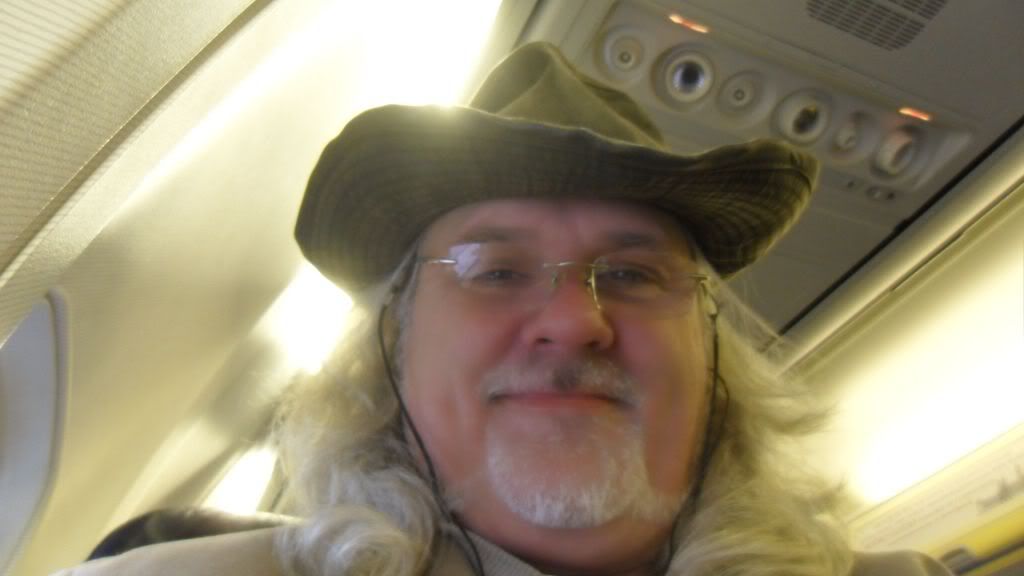
Now my next hurdle was getting through security barrier where everyone gets scanned, I had planned ahead, and put all my metallic objects into my hand luggage, placed my hat, jacket on a tray next to my now practically bursting at the seams hand luggage, and then cautiously tip toed through the scanner and heard... nothing! Success! this was going well, until I realised I had left my shoes on the other side of the barrier! So sheepishly I got the security guard to stop the flow of passengers through the scanner so I could pick up my shoes and place the onto the conveyor belt to be scanned for perhaps hidden contraband or tightly packed explosives, but nobody said anything as I walked through the scanner for the second time to collect my freshly scanned shoes on the far side (funny how walking back through that scanner thingy draws everyones attention LOL!, pity the scanner doesn't knock out that man pong from well worn trainers!
Going through the gate to the duty free area of the airport, my senses were quickly attacked from all sides by fabulous wealth and opulence on display for the urban traveller to browse and buy before embarking onto their flight. As a non drinker and non smoker I quickly walked past all the pretty bottles of coloured water and vast quantities of packs of rolled up dried tobacco plants, and I quickly found myself in front of the one shop you always find in these airports, the one especially designed to catch most men of a certain age eyes, the electronics consumer store, full to the brim with all the latest must have gadgets, and even the option to buy cases for all these must be seen with gadgets! Not forgetting those ridiculously over-priced earphones, to use with all these gadgets. My eyes were practically starting to water at the sights of all this expensive plastic that would be worthless if dropped. My head happily intervened, I already had a bag, full suitable must haves, and really didn't require any more, for one thing, I'd have to pay extra to bring whatever I bought back, and I had just so many jacket pockets free!
I eventually found myself in the area of the airport everyone ends up in at least once during all their waiting around to board times, the food court! now all my visual senses were useless here!, except that is for my nose, my wife always said a way to my heart was through my nose and her cooking! I decided, as I hadn't had a breakfast at home, now was a good time to fill my belly before this epic journey begins in earnest. I decided on a Traditional English breakfast, egg, sausage, bacon, mushrooms, a fried tomato, baked beans and that ever so famous English side dish, hash browns? I followed this down with a nice small bottle of real orange juice, the one with the real bits of orange left inside to enhance the natural taste of the artificially created orange juice tasting liquid!
Feeling warm and with a full belly, I eventually found myself heading for the gate when my flight number came up. When I got there, I found loads of other passengers milling around waiting for news of the flight and the gate opening, I took a seat and waited. It was while waiting I saw that Ryanair had made two aisles from ropes leading up to the gate doors, one marked Priority booking passengers only, and the other (a much wider and larger aisle) labelled Other Passengers, why so large I wondered? Were Priority passenger thinner? yes that must be it, I thought.
When the tannoy announced that the gate was now open, could all the Priority passengers please make their way to the gate for boarding now, three people got up together with their large amounts of drinks and ciggy's and went to to meet the girl at the gate who checked their passports, lucky blighters! I thought, getting onto the transit coach first. After these three were safely on board out of harms way of the rest of us, the tannoy announced that the "Other" passengers could now make their way to the gate, which they all did, as I was listening to some Adele on my own must have MP3 player, I soon realised that I was the only one left in the lobby as I saw the last few walking through the gate! I quickly gathered my meagre belongings and found myself the last one to go through the gate and onto the transit bus to take us to our plane, it was funny seeing those three priority booking passengers with their faces pressed up against the bus windows near the front, as I stepped into the rear door of the bus. The journey to the plane was quick and when we pulled up next to the plane, the driver opened the front doors first to allow only the Priority passengers off first, followed in hot pursuit by the hordes of Other passengers, it was crazy watching them all funnelled into the flight of stairs at the front of the plane, it was during this stampeded, I noticed a second and as yet, empty flight of stairs leading up to a doorway at the rear of the plane, it seemed silly to ignore it, so I waddled over and started up the stairs, feeling a bit like some celebrity or famous diplomat of sorts, all by myself on this empty flight of stairs, then others in the horde saw what I had done and a few at first broke away from the main herd, then more and more, but I managed to reach the top of the stairs and calmly walked into the empty rear section of the plane before this horde reached my flight of stairs. Welcome aboard said the pretty flight attended and ushered me in, I could pick any of the empty seat, that stretched what seemed forever in front of me. In the distance near the front I saw the reason for the stagnant march up the first flight of stairs, the priority passengers were busy standing in the middle of the aisle trying to get their hand luggage and large amounts of coloured water and packets of dried tobacco into the tiny overhead compartments. I happily strolled along one half of the plane past all the empty seats and eventually took one next to a window. So much for Priority booking I thought! Trying to fasten that ridiculously small belt around me made me wish, I'd never had that breakfast in the airport lounge earlier!
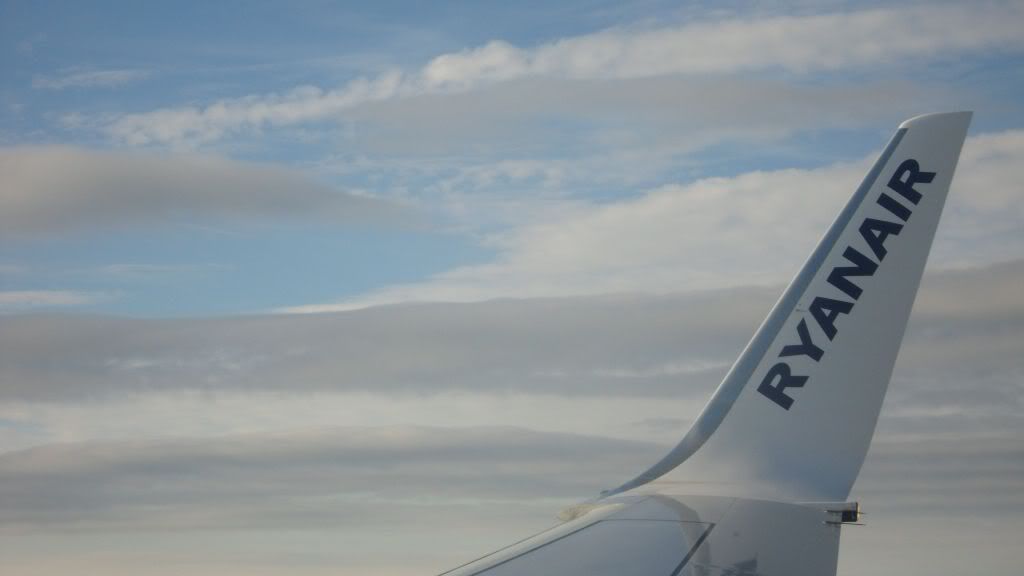
The flight, if you could call it that, was over before it began, it seemed, Newcastle to Dublin consists of basically two stages, take off to gain height, then descending to land, there was not much flying time to speak of. I do love looking at the fluffy clouds whilst the attendants art practising their semaphore signals to one another down the aisles, wish I could hear what she was saying, but my seat was directly above the two large stewardesses hair dryers, well they sounded like hair dryers.
and soon after a bump or two and a even louder screeching of brakes, we had finally landed in the land of the Leprauchauns, Dublin!
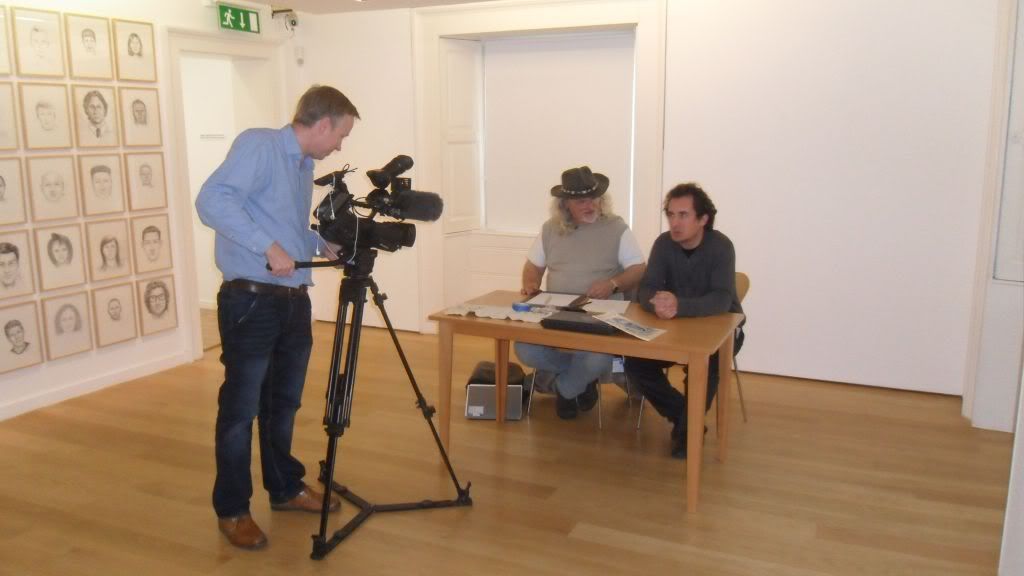
I got a taxi from the airport to my Hotel, but before reaching it, the Museum phoned and asked if I could come over earlier than planned as the Irish Press and TV crew wanted to film me sketching! So straight to the museum I went, where I met the lady who had organised my trip here, Maeve Butler, who signed me into the gallery and took me up a several flight of stairs into the main gallery, puffing, panting and red faced and out of breathe I stumbled into the main gallery to be met by 20 or so people who were waiting to meet me, Maeve introduced me as the sketch artist, and to my horror asked the waiting audience if they had any questions for me! Talk about a fish out of water, but eventually I get my breathe back and was able to answer all their questions with a few returned smiles and applause.
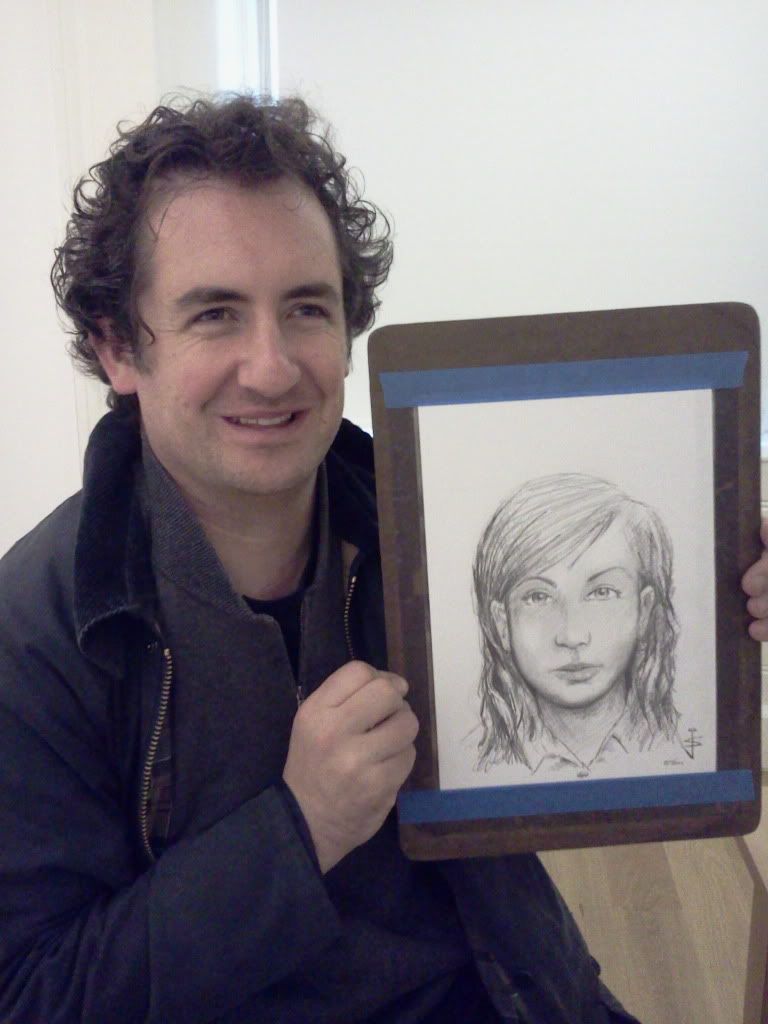
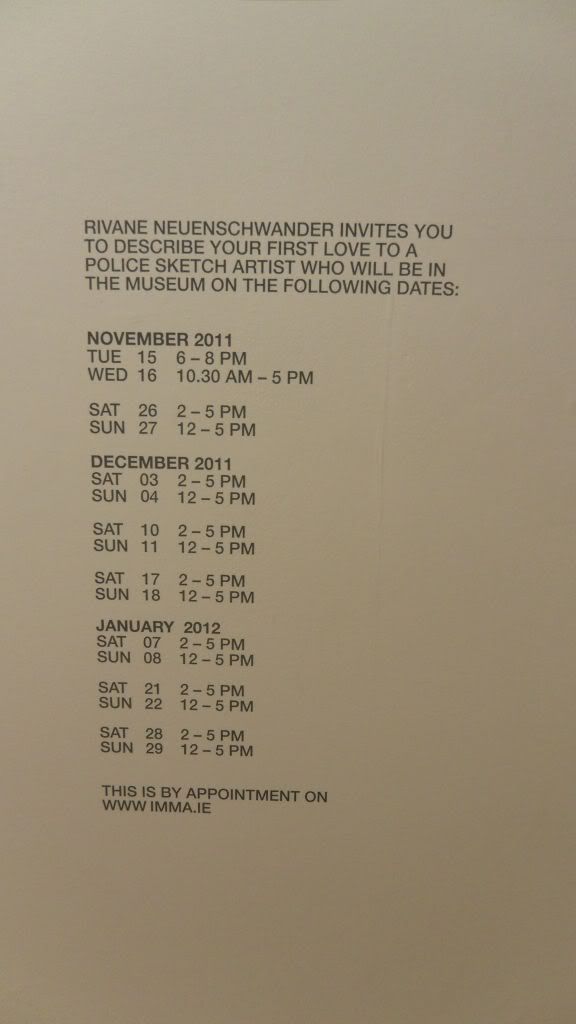
Maeve then showed me to the desk where I would be sitting and introduced the first person to describe to me their First Love, a member of staff called Stephen Taylor.
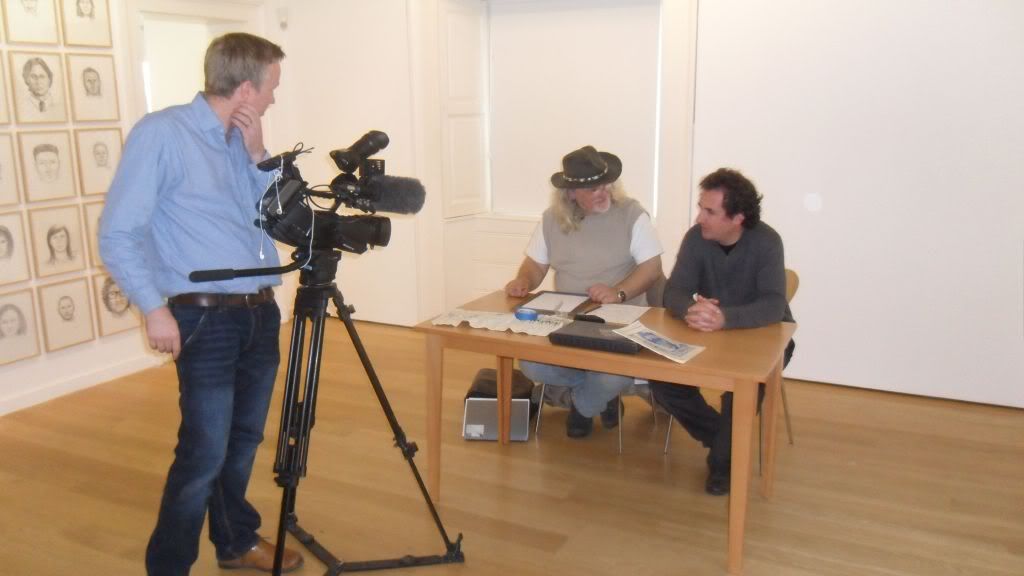
The film crew and director appeared out of the crowd and starting directing me on what he wanted for the TV footage, I hadn't even had time to take my hat off! If this was only the first few hours of the first day of my first trip, how on earth was I ever going to survive this ordeal!
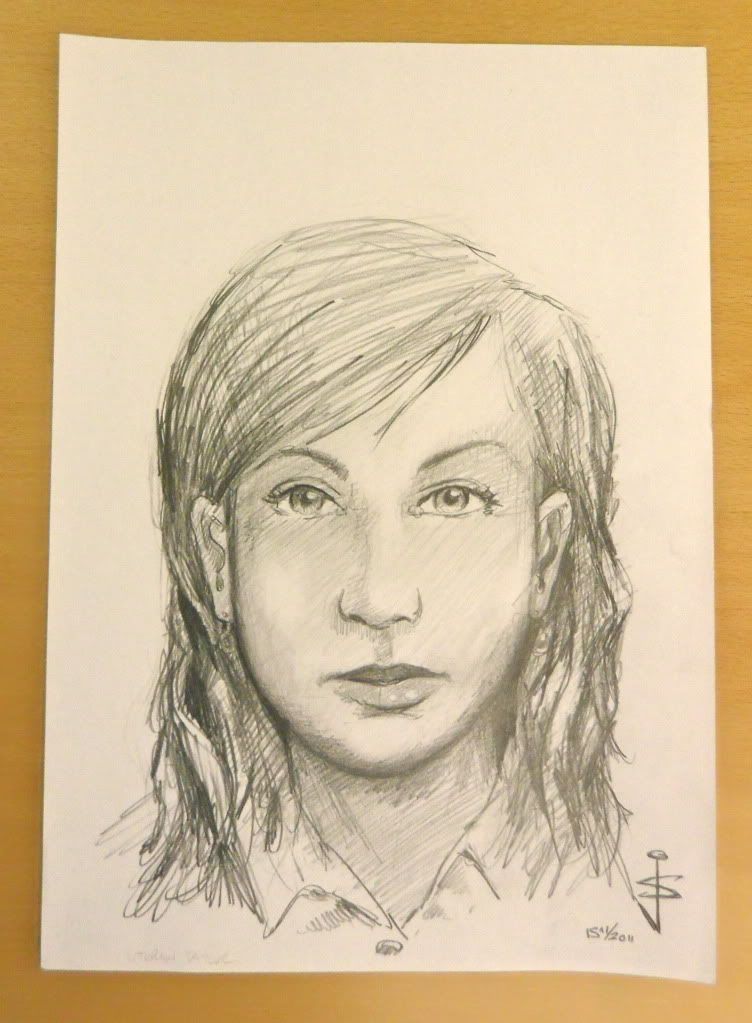
Especially with seven more trips planned into my schedule over the next several weeks. The twenty or so years working as a Police artist took over, and soon I was back into my stride, asking Stephen about what he could recall and me sketching it all down just like I had done thousands of times before, this time in front of Irish RTE News cameras.
| Stephen Taylor's "First Love" |
After the film crew left, I stayed on a sketched a couple of more "First Loves" with some pre-selected guests chosen for this opening evening.
Thirty or so minutes later, I found myself in one of the great halls were we were giving wine and sparkling water to drink and were I met Rivane Neuenschwander, the Brazilian artist I was here to help in her latest exhibition, she is one of the most interesting people I had met so far, and thanked her for inviting me over to Dublin. When the glasses were empty, we were ushered into another beautiful hall, this time with perfectly laid out dinner settings, and personalised name cards for each guest, I have finally made the big time, I thought, as I searched around the tables looking for my name card, I soon started thinking, as I couldn't see my name anywhere, then perhaps I shouldn't actually be here (wouldn't of been the first time I've put my foot in it!) but someone directed me to a table where my name was indeed beautifully hand written on a mustard coloured card, next to a Poet and one of the Museums residential spatial artists, Victorrio (sorry,didn't get his last name) and opposite was Janice, one of the gallery staff and next to her the Brazilian Deputy Counsellor from the Brazilian Embassy in Dublin! The meal was delicious, sorry I can't tell you what it was, but I had what looked to be the smallest chicken in the world in a very delightful sauce. I never thought I'd go the distance, as I definitely do not mix in these kind of circles, but mix I did, and eventually, tired, fed, and a little worse for wear (that was definitely sparkling water I drink wasn't it?) I found my way to Kelly's Hotel in the centre of Dublin, fell onto the bed and finding a remote switched on the wall mounted TV to see MY UGLY face staring back at me, it was the RTE News with the article all about my day at the Museum! They must be starved for decent news I thought as I drifted off into a deep sleep, dreaming of Priority Passengers and faces of First Loves.....
Well, I seem to have been making news headlines in Dublin! Here is the news report of my first working visit to the Irish Museum of Modern Art. You'll have to scroll for about 20 min into the video.
Sunday, 13 November 2011
The Cottage
Paper: Arturo Stretched canvas
Size: 24″ × 15.5
Duration: Approximately 8-10 hours over two to three days.
Saturday, 29 October 2011
The Stream
Paper: Stretched Canvas
Size: 510mm x 700mm (20″ × 27.5″)
Duration: 12 hours (over three days)
My Last Love
Medium: Pencil (leads F H 3H 4H 5H 6H 7H & 2B)
Paper: White acid free cartridge 140gsm
Size: A4 size - 297mm x 210mm (11.7" x 8.3")
Duration: 2-3 hours approximately
This is what I set my students in my drawing class this week, they despaired at the brickwork, so as their teacher I had to show them how I would tackle this subject, and this is the result.
My first love (after the wife and family of course!) is, without question my art and in the ranking of things I love, gardening definitely comes last, hence the title.
The reference, is a photo I took of my garage/stables which I'm currently converting into my new art studio which you can read about here: http://www.redbubble.com/people/szymczuk/journal/7713676-converting-my-garage-stables-into-an-art-studio-part-1/ I decided that the evening light was casting some magnificent contrasting shadows onto the old brick wall and I just had to capture it (mainly before the walls get insulated).
Here are a few close ups of this finished piece:
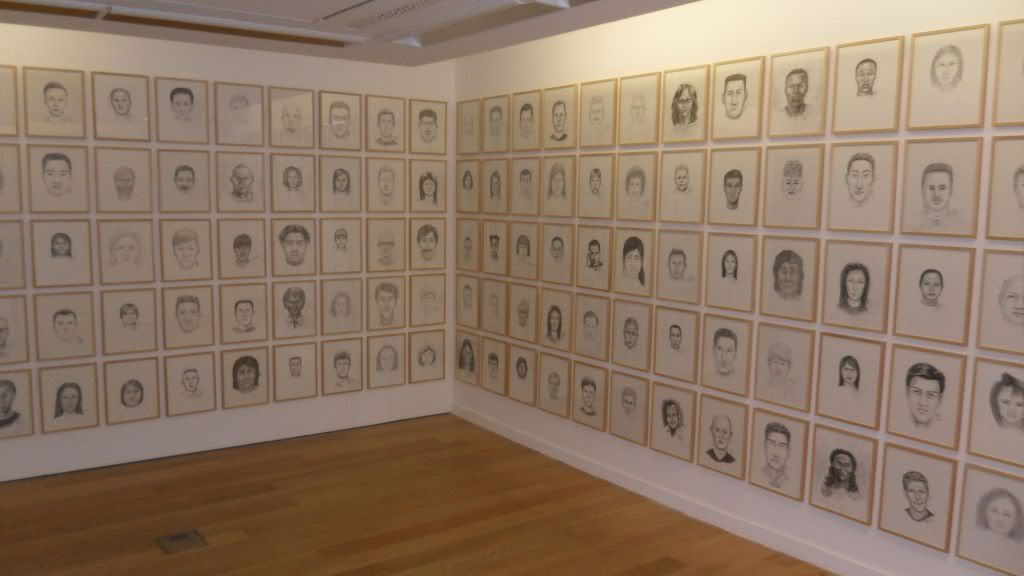
Soon appearing in the Irish Museum of Modern Art
Saturday, 18 June 2011
Jed

Medium: Pencil – Pentel Mechanical Pencils (P203, P205, P207 and P209 – Leads (2B, 3H and F)
Paper: Goldline Bristol Board 220 gsm
Size: A3 420mm x 297mm (16.5 inch x 11.7 inch)
Duration: 7 hours
This is my drawing for the International Drawing Day 2011. I started this morning and have just finished it.
I’m really getting into using these embossing tools now, they are absolutely mint for creating fine medium and coarse fur, which this chap had in abundance.
THE SLIP AND SLIDE METHOD – with an introduction on Embossing techniques
Reference:
The source reference is from a photo I took of a dog called “Jed”, who I was commissioned to sketch and decided to create the artwork on June 4th, International Drawing Day.
Weapons of choice:
Pentel Mechanical Pencils (P203, P205, P207 and P209 – Leads (2B, 3H and F)
Pair of scissors (borrowed from our sewing box)
Electric eraser
Kneadable eraser
Derwent Essential Embossing tool set
Copious amounts of tea (Earl Grey?)
Digestive biscuits or Jacobs Cream Crackers (optional)
Paper:
Paper: Goldline Bristol Board 220 gsm
Size: A3 420mm x 297mm (16.5 inch x 11.7 inch)
Introduction:
This “The Slip and Slide Method* as I like to call it, is something I created for some of my drawing classes I used to teach locally, some of my students were always having problems trying to get the basic outline of whatever they wanted to sketch down on paper, invariably they were out of proportion, ran off the paper (we’ve all done that at least once right!) or the images were so small as to make working on them nigh impossible. So out of necessity I came up with this The Slip and Slide Method(it probably exists in some other form with some really classy name, but I don’t honestly know of it – that’s for the copyright lawyer folks out there!) probably started in my days as a Police Artist at New Scotland yard, back in the day (before computers and tinternet) when we used to use Photo-Fits to create faces, these were basically pieces of facial features in strip format, an police artist/operator would put together to compile a face of a wanted felon.
I guess I wanted something that any student could get an outline off their reference and onto paper, quickly and with the least bit of hassle involved. Something that would keep their work fairly tidy and comprehensible. Both left handed and right handed folks be able to use (yup, I’ve seen a left hander use this to their satisfaction).
If you know anything about me and my art (sketching and painting) I live by a simple law, “I draw (or paint) what I see”. So I decided that if I wanted to sketch an A3 sketch (20mm x 297mm or 16.5 inch x 11.7 inch) then I’d use a an A3 size reference (straightforward yes?), OK I realise that this is a big size and I’m lucky enough to have an A3 scanner printer at home, but if you are not as lucky to have one yourself, don’t panic, get to your your local photo-copy (xerox?) store to blow up your reference photo to the same size you are comfortable with sketching and in black and white. If we are going to sketch in black and white we really need to see the reference photo also in black and white (OK painters, you can use a colour reference, but may I just ask, why are you in my class? This is for pencil pushers only!)
We could go straight into Step 1 below, but I like to put my reference through the computer first and play around with filters and such in Adobe Photoshop (if your not into computers or Adobe, don’t worry, this bit is only for the computer nerdy artists out there… I scan in the original photo and after cropping it to a suitable size and proportion, I mask out the background clutter and erase it with only the dog itself on a white background (this helps you concentrate on your reference only – I suppose you could cut out the subject in your reference photo and get it photocopied on a white back drop).
I decided I wanted to give the bottom of the sketch something snazzy and cool looking, so I made a mask of zig zags that dwindles down to the bottom right hand side of the picture. I would love to be able to get quality source of beautiful zebras, cheetahs, leopards and tigers, but as they are few and far away from here in the UK, I thought I might use some kind of stripey effect to try and give my sketch something to make it stand out in the jungle of all those other beautifully sketched and painted dogs online. I’ve used this zig zag effect before and it seems to work Ok, especially with a dark dog.
After I’ve got the effect I want, I play around with the on board filters, high structure values, brightness and contrast values until I’m happy that the reference looks exactly how I want it to look like for my sketch, I print out an A3 size copy on photo paper (this or inkjet give you the best contrast in the printout).
Step 1
Here I have the reference printout I’m going to use for this sketch. It is the same size as the paper I’m sketching on. Which is going to make comparison whilst sketching easy to see.
Step 2
The first thing I do is to use the scissors (please little ones, have a grown up present or ask them to do this bit for you), and cut the reference printout into five fairly even strips or slips, vertically. See this is why I called the first part of my method slip, (and you folks in the back of the class, can stop giggling now!)
Step 3
I then position the strips onto the paper, roughly where I want the sketch to be placed, this makes sure your sketch is atheistically placed, where I think it looks best.
Step 4
Being right handed, I’m using the first strip on the left side (all you left handers can use the the last strip on the right hand side) I then keep this strip in place with one hand and use a pencil to mark the top width on the paper, just wee little marks only please, but enough so you can find them easily.
Step 5
I then mark the bottom width of the strip on the paper, again with two wee pencil marks, similar to what I did in the step above.
Step 6
Now the slip sliding part comes into action here, I’ll go slowly so those at the back can understand (George! please pay attention! and Barbara! take that chewing gum out of you mouth now girl!). I’m using my left hand to hold the first strip in place (checking that it is within my four marks on the sketch paper (left handed folks just do the reverse of what I’m showing you). Holding my pencil in my right hand leaning on the sketch paper and not on the reference strip just a few millimetres above the point of the ear I air draw the top peak of the ear, air drawing is like air guitar – not on the reference strip or on the sketch paper but just above where it is shown on the reference strip.
Step 7
I know it sounds stupid, but bear with me OK? When you are confident you know where the tip of the ear is going to be, keep your pencil hand steady on the sketch paper and with your left hand slip the reference away only enough to show the sketch paper underneath and now with your pencil hand (still steady on the sketch paper and the pencil hovering a few millimetres above the paper) pencil in lightly an ear tip on the sketch paper. Imagine the strip of paper is like a playing card, well just like a playing card, you can move it to an fro back onto the sketch paper (between the marks you pencilled in, remember those?) with a bit of practice, it is just like moving playing cards on a poker table (OK Marlene, Tarots cards are fine too!). Thus was born the name of my Slip and Slide method! So until I hear of a better title, this will have to do.
Step 8
With your reference strip back in place (between the pencil marks on the top and bottom) if you look at the right edge of the reference strip, you can see divisions on the reference where light begins and dark area end and so forth, well now we can mark some wee lines onto the sketch paper where these light and dark areas begin and stop, try and make the marks go in the same direction the divisions are going in (i.e. see those bits of white fur in the ears, and how they are kind of diagonally on the reference strip? well follow through on the sketch paper with your marks.
Step 9
Now using this remarkable low carbon footprint method of Slip and Sliding, use it to begin marking a few marks of the outline of the ear, it’s a bit like joining the dots, if you have enough of them, you can very quickly join them up to one another and the edge marks you’ve already placed down.
Step 10
Continue using the slip and slide method to track the outline of reference onto the sketch paper, when you get a bit faster (as all my students did) you can readily check some marks you’ve already placed down if it gets a bits wonky here or there.
Step 11
We now should have enough marks on the sketch paper for a fairly accurate outline the ear.
Step 12
I carry on down the reference strip to begin marking out the shoulders of the dog and the edges of this zig zag finish I want to sketch. You can see how I only marked the corners of each zig zag and then I simply sketched in between my marks in a zig zag fashion. My students found this is a real quick and dirty way to get the reference outline onto the paper, accurately and fairly quickly. Catherine! stop looking out of the window, and please try and pay attention!
Step 13
Going back to the ear, I sketch in freehand the structure of some of the inner fur and lighter sections, as it is only a small section of the whole sketch, you may find this easy to do as well, if not, then use the slide and slip method to help you get the structure lines you need.
INTRODUCING EMBOSSING TOOLS
Step 14
Okay now for the fun part you’ve all been waiting for, using your embossing tools (Barry!, please be careful! they are not swords!) in this part of the sketch, I’ve marked a few light hairlines and whiskers, that I want to make stand out, in the days of old, we pencil pushers had to either sketch around each whisker and hairline we wanted to stand out, making sure we didn’t sketch over it or perhaps we sketched in the fur and used a very thin edge rubber or electric eraser to make those whiskers right? Well, I’ve since found that these embossing tools are the bees knees for getting fine lines, whiskers and hairlines onto your sketch. The Derwent set comes with two embossers with a ball point tip on each end, one with a tiny and small tips and the other with a medium and larger tip (I’ll call them 1, 2, 3 and 4 – 1 and 2 being the tiny and small embosser and 3 and 4 the other medium and large).
Using the No.1 embosser, I press into the sketch paper (over the outline I’ve marked and joined up) I’m using the embosser like I would use a pencil (so you pencil pushers should be OK here), if I was using a pencil, I would press harder for a thicker line and lighter for a thin line, well I’m using the embosser the same way, for a thick whisker, I press hard going lighter for the thinner tip of the whisker.
Step 15
I use No’s 1, 2 and three for various thicknesses I want to achieve. On the heavy paper I’m using (220 gsm) it allows you to carve in beautiful grooves. I also use the tips of the embossers to place small hole indentations here and there, and those few odd speckles of white and light tone you find on your reference, (this, I find, is what makes my sketches seem photo-realistic) but please be careful not to puncture the sketch paper, which is why I like to sketch on a hard cutting mat or board.
Tip:
For a white whisker on your sketch, use the embosser on the sketch paper, for a shaded toned whisker, use the embosser on the pencilled line so that the pencil is inside the embossed groove.
Step 16
Once I have carved in enough whiskers and hairs I want standing out, I begin to hatch over the embossed area with a 2B pencil, keeping the pencil strokes fairly tight and always going over the grooves and not into them. You will notice as you hatch over in pencil the lines you embossed earlier, magically start appearing.
Step 17
The more you begin shading, you soon realise that you can easily carry on shading as normal, because every time you go over you embossed grooves, they stand out more and more, in the old days, you had to take great care to define the edges of whiskers as they sometimes collected more pencil along their edges when you try to keep them tidy, embossing (I find) lets you get on with getting your tonal shading spot on without worry about having to negotiate around those pesky whiskers all over a dogs face! You can easily pencil and hatch light or dark between whiskers you predefined with ease.
Step 18
Here you can see how I’ve feathered the dark fur into the white fur and begun to show a few hi-lights here and there.
Step 19
I’ve moved up to the base of the ear, and used Embossers No. 2 and 3 to cut in a few curved hi-lights and then gone over in a 2B pencil to blend those hi-lights into the darker fur.
Oh there goes the bell! well that’s all for now boys and girls, thank you for your time and please remember, to bring your work books into class tomorrow, and we will continue sketching Jed the dog.
Thank you for your time and especially your patience in reading this tutorial, I do hope you now have some kind of insight into my slip and slide method and introducing the Embossing tool. I will carry on with the full sketch later on.
Jan (happy sketching).
Sunday, 17 April 2011
Tutorial - Painting the sailing ship Traveller
Painting the Traveller
Reference:
The source is from a 3D Bryce stock model by the artist Andy Simmons who has kindly given me permission to use his rendered model of the Traveller as my reference for this painting in acrylics (thank you kindly Andy).
Tools:
Acrylic colours:
Winsor and Newton & Basic Acrylic paint:
Phthalocyanine Blue
Primary Blue
Dioxazine Purple
Cobalt Blue Hue
Ultramarine
Light Green Permanent
Hooker’s Green
Raw Umber
Yellow Ochre
Cadmium Red Medium
Titanium White
Brushes:
Round No.4
Rigger No.1
Point No.6
Filbert No.8
Flat No.4
Hog Hair No’s 2, 6 and 10
Water de-mister spray bottle
An old wet rag
Canvas:
16” x 20” stretched canvas, on a standard wooden easel. I have found that my easel is slightly too small at about 5 foot 6 inches against my height of 6 foot. So my unique solution I’ve found that works for me, is simply to remove the extendable leg sections and then sit the easel onto my drawing table, now it is the right height. I also found that two of the legs come in very handy indeed to wedge the canvas between the two with the top leg section acting as a kind of arm to clip my reference printout to. The reason I clamp my canvas between the two leg sections is also to stop those two horrible white marks you find you get when you finally remove the canvas and have to match the spaces up with the surrounding colours.
Palette:
A (very quintessential) Chocolate American tin with a pre cut canvas sheet on top of a thin wet sponge. The wet sponge keeps the acrylic paint from drying out too quickly and together with the de-mister spray bottle of water it lasts well into the second day.
So now that I’m all prepped up, here is the step by step process of how I painted the beautiful nautical scene the Traveller in just over 10 hours over two days.
DAY ONE
Step 1
I previous prepared my canvas using white Gesso (giving it two or three coats) and once dried, I traced the rough outline of the ship roughly in the middle of the canvas. I wasn’t too particular about details like rigging lines etc., all I wanted were where the main sails a hull were going to be placed. Anyway, I realised that too much detail in the tracing simply gets obliterated as you begin blocking in.
Step 2
I add a peanut size of Hookers Green, Yellow Ochre and Titanium White and mix the ochre with the white and start getting some paint onto my Hog Hair No.10 brush, the brush, the brush, I first wipe with my wet rag to get get it a little bit more pliable.
I OK, now with my heart in my mouth I approach my canvas like pressed ganged sailor with a little bit of fear and in trepidation, but mustering up a bit of dutch courage, I start randomly to begin dry brushing the paint into the top left hand corner of my canvas, I am not on making it a beautiful coat or a wash, this is going on quick and dirty.
Step 3
Now with a bit of wind in my hair, my confidence rises with each dry brush stroke (I seem to be getting a feeling of being an old sea dog or maybe a pirate even!). I Dry brush my yellow ochre and white mix into the lower right side leaving a good chunk of canvas untouched (this is for the clouds to come in later). I even add a wee dab of my mix into the rigging where I think the sky is showing through.
Step 4
Back to my palette, I add a peanut size of Cobalt Blue and take a little Hookers green and a touch of Ultramarine a pinch of White and mix up a dull greener blue mix I then blend a little of this new mix with the cobalt blue and the white with my smallest hog hair brush and somehow arrive at (more luck than purpose I suspect, but isn’t is the magic of learning how to paint right?) a blue sky for that top right corner.
Step 5
Now using the largest hog hair brush recently wiped clean with my wet rag, I return to my palette and start a new mix between the Hookers Green and the Ultramarine and find I have to add a peanut flavour of the Dioxazine Purple (this really sounds almost hallucinogenic doesn’t it?) I’m looking for that really dark foreboding storm colour (do people still say foreboding? maybe it’s because I’m about to introduce a storm cloud).
Step 6
Using the large No.10 Hog Hair brush, I begin introducing this ghastly green mix into the canvas from the top left corner, working downwards.
Step 7
I quite vigorously continue to apply this really green mix, down from the top left hand corner of the canvas, applying a dry brushing technique by turning the brush left and right, I am slowly but surely adding this darker tone colour into the canvas while at the same time leaving some yellow ochre mix showing through. This darkness continues to the top of the ship but fades out halfway across. I continue up to the hull stopping at the horizon.
Step 8
I’m now really getting into this painting scene and now I need to start blocking in the rough sea. The colour I’m looking for starts with mixing the cobalt with white then pushing through into the storm cloud colour I mixed up earlier. I keep fishing around on the palette till I get a darker sea colour I’m looking for.
When I have the colour I want, I start dry brushing it into the canvas starting from the bottom left corner, stopping about halfway.
Step 9
I’ve decided to try and balance all this darkness and despair I’ve been painting by moving over to the right hand side and into the top right hand corner, mixing a pale blue for the body of the clouds and dry brushing this blue into the clouds leaving a yellow ochre mix showing at the edges. I’m trying to get that white blue cloud which still has some body of substance to it, not as deep as the storm clouds on the other side of the ship, these are happier fluffier clouds. I can see that the ship is going to anchor itself between these two states of dark and light (I’m so sorry, but I just can’t seem to stop these nautical puns!).
Step 10
Using the rigger brush (no pun intended here, it actually is called a rigger brush LOL), I apply a thin lining arc to the top most edges of the main cloud.
I want to strengthen the edges of the clouds on this side, with some light fighting back.
Step 11
I return to my palette and start mixing a bit of the Titanium White into the Hookers Green, I’m now looking for that rich underwater green surge that I want in the centre of the main wave, you know the colour you dream of seeing whilst surfing on a beautiful Hawaiian or Australian beach.
I quickly add this green into the centre area of the sea and at the same time grab some darker blue from within my now fluid palette and blend in some water on each side of the green surge. I also try adding a few darker blue strokes at the base of the ships hull and to the edges of the sea on either side of the canvas (I can almost hear Enya singing Orinoco Flow in the background, listen, LOL). I also start adding a light Titanium Yellow Ochre mix to the two sails on the far right of the ship
Step 12
Being a bit adventurous now I add a peanut size quantity of Cadmium Red Medium and using the small round No.4 brush mix a pinkish colour betwix (a great word that, we need to use it more, all who agree say Aye, Aye Captain!) the Titanium White, Yellow Ochre and this shiny new Red, till I get that wonderful pink sunset colour.
Step 13
I start picking out a couple of sails I started earlier with this pink, brushing with down strokes and adding a slightly darker red pink at the base of the sails, using white, whilst still wet I blend in some hi-light into the tops of these sails. A also start blocking in these three striking forward sails in a darker blue but still very rough, nothing definite.
Step 14
Back on my palette I start a new mix betwix (see I just had to use it again!) the Ochre, White and the Red with a splash of green till I gel a wonderful canvas hue (see below) and with this colour I start painting the main sails adding darker green sections where the shadows are going of those three main blur forward sails.
Going back to the canvas colour I’ve just mixed I add more of the red to give it an earthier tone and start working on the sails on the dark side of the painting. Again adding more red to darken the bottoms of these sails. I’m not really taking to much care blocking in these sails in the first stages. I am also seriously beginning to lose my pencil marks (see, I told you!). I also add a hew dabs of lighter canvas tones onto a few protruding pieces of hull.
I paint in the top sails a very light pink tone and notice now that the whole ship is tarting to look like a bright pinkish lantern at sea, this is great as I want to show that the sails are reflecting the pink sunset which is behind and to the right of the viewer.
Step 15
I am now introducing two more colours to my palette, these are Raw Umber and Mars Black. Now taking a smidgen of the Dioxazine Purple I start by mixing a darker purple-ish blue
With this new purple/blue mix, using my filbert brush, I now start painting a few dabs or puddles of colour sweeping up from the left side into the dark side of the surging wave, I try to make the dabs go smaller at the top nearer the hull of the ship (to give distance). I also lighten the mix with some green and white and try a few greener dabs near the bottom of the canvas and at the apex of the wave as well as a couple of darker shadows underneath two of the turning wavelets (have I just invented yet another word?). I added darker navy blue strokes using the large hog hair onto the waves on the dark side of the sea up to the horizon.
I also begin to paint the hull with an initial dry brushing initially with the Raw Umber for the front and back of the ship (the bow and stern? – I don’t know which is which, sorry!) and then using a mix of the raw umber with both the red and purples on my palette I paint in the main body of the hull. I use the Raw Umber for the pointy bit at the front of the ship (apologies to all you sailing folk, this is so so embarrassing when you don’t know what these “bits” are called).
Step 16
I’m concentrating on the darker colours in the bottom right hand corner of my palette, mixing betwix the black brown and purple, this gives me a wonderfully deep blue.
I now pick up my flat No.4 and with this dark blue mix, start painting in some deeper shadows in the foreground of the waves to the right hand side of the sea, taking care not to to paint too much, this side has to still be blue in colour but not as dark os the other side. I also try the filbert brush for the smaller darker waves near the horizon
Step 17
Now is the time were only the real intrepid sailors dare voyage, yes, you’ve guessed it, into the dark side, that dark and foreboding (there’s that word again!) storm clouds. I use the same dark blue mix that I was using in the bottom right hand corner of the canvas, but now in the top left hand corner of the sky (like am I doing a diagonally opposed painting). I paint in a stronger area in the top left corner and dry brush downwards towards the horizon, but at the same time still try to leave something of the original ochre layers coming through, just enough as to give a hint. I diagonally oppose that patch of sky with a warmer greener grey (almost battleship grey) on the right hand side of the canvas near the horizon (this gives a wonderful soup green colour against the blue waves divided only by the white of the waves on the horizon. I carry on painting with this warmer grey using a smaller round brush) up to a straight painted line of the lower right hand sail just below the pointy bit at the front of the ship (what is that called?)
Above the top most sails where the light and dark meet, I paint in some different degrees of blues and paler blues even going into a light turquoise blue, which I continue into the clouds on the right of the ship. I pinch a bit of that warmer grey from the right hand side horizon and paint it on the right of the top most sail.
Step 18
Using my large hog hair, I start blending in some more blue into the dark side of the sky. I also begin in earnest to define the foreground waves on the left side, using my rigger brush with darker blues hi-lighted with lighter green blue around a few of the puddles that that rising wave forms, as well as picking out some hi-lights to foreground waves. I play around with the white spray at the front of the ship (making it come more onto the sea and higher up on the left).
Step 19
Now I’m giving all my attention to the waves, their patterns in the green surge and the shadows in the foreground, I am trying to make these waves flow, which is harder than it looks, you have to paint in the direction of the waves, as to go against them you will surely perish in the attempt! (so sorry about that one, it has been a long day).
I bring in hi-lights on both sides of the mighty wave and then push some of it back by going over with blues and green. This bit, I’m finding really intense, as whatever I paint impacts upon it’s neighbor, in fact it is a race to keep in front of this fast crashing wave (I suppose this is how a dolphin must feel running in front of a fast moving boat – hmmm painting nautical scenes really gets your imaginarium of juices flowing (now how on earth did the film Dr. Pharnassus come into all this? I must be getting tired). I also add a couple strands of rigging under the front section.
Step 20
Okay the light is starting to go, and I must be near to bringing todays painting to a close, but not before I do, I must just paint one sail, yes only one, otherwise I’ll never get to sleep, will I? I start on that bottom right sail and paint in some yellow ochre with a few lighter brushed high-lights. I finish off the sail with a few touches of red-ish brown on the bottoms of the sail. Me thinks it needs a bit more pink in these sails (me thinks! – I had better stop here before the transformation into Captain Jack Sparrow is unreversible).
Step 21
I keep giving extra attention to the great wave, I keep redefining the honeycombed patterns around the green swells.
Step 22
I just can’t seem to leave this painting alone, as I add a bit more rigging under the front pointy bit. I also start to define what looks like a canon or prominent deck section at the front of the ship. Okay, i’m going to have to call it a daw for the time being, I’ve been painting for just over five hours now. Time for a break.
Thank you for your time, hopefully, I’ll see you all tomorrow.
DAY TWO
Next morning I rush into my studio, happy to see that my hearty wee ship, still crashing through the waves and I eagerly open my palette tin, yuk! it has all started to settle into some kind of psychotic artistic nightmare (maybe I should enter this palette for the prestigious Turner prize instead, what do you think?). Not to worry, today is the day of the little brushes, I decide that bigger brushes will only be used if I really need them. Anywhoo, the palette is beautifully set up now for me to simply dip my smaller brushes into it, picking any of the myriad of colours flowing in the rainbow currents before my eyes (hmmm this nautical infection is starting early, best press on).
Step 23
I see a wonderful pink flow in palette betwix the white and red, and eagerly dip my pointed No.6 brush into this rainbow palette and start painting in the top sails, starting from the right. I then carry on painting the pink into the second tier of sails.
Step 24
I’ve decided that the reference photo I have clipped to the spare extension leg on the left of my canvas is too far away, as I’m going to be working on the detail of the ship, I need something closer easier at hand. So, I cut up an A3 printout ( 16.5” x 11.7”) of the reference image, into three vertical strips and tape the first two (butting up against each other) on the left of the canvas to the extension leg on the top and the third, I again tape to the top of the extension leg, but on the right side of the canvas. The idea (it does work, honest!) is to be able to swing down any strip so I can compare what I’m working on easily, and when I need to see the whole canvas, I can swing them over the extension leg and behind the canvas. Weird I know, but similar to my drawings, I like working in strips.
Step 25
I clean my pointed No.6 with a freshly dampened wet rag, and start mixing a canvas colour I can see in the palette, the more I mix it up, the more I can make a little puddle of the colour I’ll need.
Armed with this new canvas colour, I start painting onto the sails adjacent to the dark side of the sky.
I return to the palette and make a new puddle of colour and sweep in some blue and make a tonal difference to the canvas colour and use this also on the same sails. Working between these two newly created puddles I blend in the left side sails with the darker tones near the bottom of the sails.
Step 26
Using the darker of the two new puddles, I start working on the shadows of the sails, these shadows. as best as I can make it are from the three dark blue sails at the front of the ship. After I have painted them in, I use the smaller hog hair (slight dampened) to brush away some excess paint to reveal i subtle hi-light, which makes the sail look kind of semi transparent (this is exactly the effect I want.
Step 27
With the first vertical strip swung down, I can easily compare the sails I’m working on. This really does help me achieve the effect I want on the sails. I start on the middle sail on the left side, paint it n with a purple/grey mix and using slightly darker paint, I start putting in a few vertical lines on the sail itself, I’m trying to replicate the stitching sections of the sails.
Step 28
I continue painting the bottom sail on the left hand side of the ship, keeping it similar in tone to the middle one above. I also start working on the back end of the ship (apologies again to all you sea folk, I promise I’ll look up the right term, honest!) and start defining the edge of the ship and some shadowy objects/people? I also try a bit of hi-light on that stick thingy (I’d never make it in the navy would I?) protruding from the side of the ship on the left hand side. I’ve decided to do a colour change on the left hand side of the top sail, I notice that there is a play of light and dark there I want to replicate.
Step 29
Now I begin moving forwards and start to paint the lower middle mast sail and also and a greener square of sail below it, almost touching the ship hull, but not completely. I use a bit of the colour I used to paint the two shadows I earlier. I add a few darker greener tinges to the base of the big sail and a few green strands hanging down onto the lowest sail. I also take time to paint in one of the light reflections onto the lowest rear sail, it looks a bit like a fat arrow, I think this is a bit of light coming through the sails from the front. It looks a bit odd, but I’ll come back to it later, this is just the bast colour of it.
Step 30
I repeat the process I did in the previous step and add some more light marks to the second rear sail, these shapes are more square-ish I swing down the reference photo to help me get the exact location of these light marks (my earlier pencil lines have long since deserted me!). I paint the slightest of hi-lights to the end of the horizontal beam at the top of the bottom rear sail. I also give a little attention to the left side of the top sail.
Step 31
My palette is starting to become as rough as the sea I’m painting! (very inspirational methinks).
Okay, back to this painting (I seem to digress an awful lot! – sorry) I now start adding some shadows of rigging shapes onto the big middle sail, and I’ve introduced some blue up on the edge of the top rear sail to match in with the two lower sails. I try painting a practice thin line on the sail I first painted using my rigger brush (the sail on the right hand side behind the sticky out bit at the front, see?)
Step 32
Now I’m sailing! I start painting in a slightly darker green on the main lower sail and define a lighter canvas green colour triangular shape inside this. I also use my rigger brush to draw a few lines across the lighter triangle of sail as well as a few lines of rigging on the sail behind this one (near the top of it). I’ve also decided that the shadow on the sails above need darkening a bit (just a tad mind you).
Step 33
I begin defining those three long blue triangular sails with some more blue, the smaller one first, getting a slightly bit darker. I also start working on the top of the ships decking, painting in the basic forms trying to define a main square bit of decking where most probably the ships wheel is situated.
Step 34
I carry on defining those three front sails with a darker tone and then when semi dry, blend in some lighter blue tones to show some flowing body to them. I also decide to start painting in some of the darker mast shapes in between the two main sails and add a few thicker darker rigging lines where needed. I repaint the sticky out pole (is it a mast?) at the front of the ship and paint a few more rigging lines coming from it. I also begin to try and pick out some structure to the main decking and side hull with some subtle lighter lines with my rigger brush. I add the faintest lines of rigging underneath the top rear sail in that lighter section.
Step 35
Now I divert all my attention to the rest of the top sail, painting in an matching it up with the surrounding sails, I give it a slight light green shadow and start painting the next central platform below it as well as the beginnings of a top mast and cross bars on each of the sails. I also use the rigger to start joining the three front triangular sails onto the main masts with a couple of bauble type shapes on the main lines supporting them.
Step 36
I bring the lower main sail down lower with painting and paint in some subtle shadows behind them at the base. I add a secondary bauble shape to the tallest rigging line of the three triangular sails and draw some fine rigging lines from it to the top platform. I’m getting quite confident with painting lines and with my pointed No.6 brush, I am able to paint the thinest of rigging lines drooping diagonally from behind the three front blue sails, and carry on up across the main lower sails. I decide that I need some seagulls on the right hand side, and using the smallest brush, paint in a few birds, smaller ones further back.
Step 37
The seagulls look great, but I need some more on the left hand side, I start with that large one in the top quarter of the dark sky, then follow on with a few smaller ones below it and even smaller one around the cross bar protruding out.
I then step back and look for a few touches here and there I think needs doing, a few lines of rigging to add over here and maybe over there? I work on the sprays of water on the shadow side of the hull, add a few whiter drops of water to the tops of the crashing waves. I even paint in a very, very subtle net on the front below the main front mast. You know something? I think I’m done. Five hours later, looking somewhat pleased and very proud of my efforts, I realise I have finally finished painting my first ever sailing ship in acrylic.
Finished
Here at long last is the finished piece
Thank you for your time and especially your patience in reading this tutorial, I do hope you now have some kind of insight into painting this beautiful sailing ship, and hopefully won’t be so afraid in the future to attempt this kind of painting.
Jan (Happy Painting)